

NMP (1-methyl-2-pyrrolidone) is an organic solvent with a high level ofCO2. The NMP project has succeeded in developing a suitable and scalable process for recycling NMP. The process stream contains a complex mixture of water, organic acids, amines, various inorganic salts, protein residues, ethanol, and NMP.
Several issues were resolved during the development work. Among other things, methods were developed to retain residues of the highly volatile organic acids and amines – while ensuring a final water concentration of less than 0.1%. It was also demonstrated that NMP is suitable for repeated process use and re-purification. Here, it was found that the NMP became cleaner with each cycle, and no accumulation of individual impurities could be detected.
The process consisted of several individual steps:
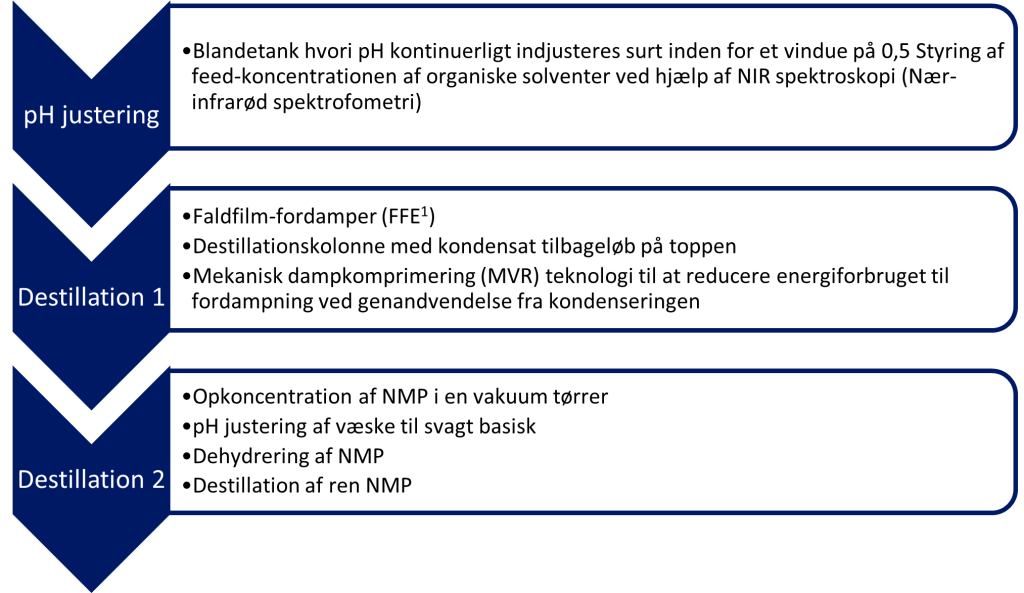
pH Adjustment of the NMP flow
pH control of the NMP-containing fraction is the first step in the process. During development, it was observed that at pH values in the alkaline range, the combination of high water concentration and high pH tended to cause excessive foaming in the process. The foam could be kept down by adding foam-inhibiting additives, but at the high pH, a number of volatile and malodorous organic amines also ended up in the distillate.
It was found that the best pH for the incoming material for the first distillation is slightly acidic to neutral. The best range for the further process is found by keeping the pH slightly acidic within 0.5 pH units. The advantage of the acidic pH range is that all the volatile organic amines are retained with the NMP, while a large proportion of the volatile organic acids are transferred to the distillate. The pH control of the NMP fraction takes place in a large mixing tank, where the pH is continuously adjusted downwards with hydrochloric acid before the first distillation step.
Distillation 1
The pH-adjusted fraction is added to the distillation column, from where it flows down into the sump and is pumped up over anFFE1. The vapor is passed through the distillation column and condensed on the other side of the column in condensers. Since NMP decomposes rapidly at temperatures above 150 degrees Celsius – where it is converted into a dark brown liquid – there is a natural limitation to the temperature that can be used in the process. In standard processes, the temperature is kept at a minimum of 50 degrees Celsius below the decomposition temperature. In order to achieve rapid evaporation from the liquid at the reduced temperature, distillation 1 was therefore tested and carried out at reduced pressure.
During development, it also became apparent that it is essential to have a reasonable return flow of condensate in the distillation column to ensure proper cooling and thus avoid loss of NMP in the distillate. Under the given conditions for the process, loss of NMP is avoided. At the same time, it is possible to achieve a concentration of NMP of over 45% above the first distillation stage. If the NMP concentration becomes too high, there is a risk of precipitation of salts and protein in the distillation column and FFE. This is undesirable, as it will lead to production stoppages and equipment cleaning. The distillate from the process primarily contains water, ethanol, and other highly volatile organic compounds. The entire process can run continuously, ensuring smooth operation of the plant, as there is no need to stop and start once distillation is underway.
Distillation 2
This distillation process is somewhat more complex and requires several unit operations along the way. The process must necessarily be carried out as a batch process with monitoring and adjustment of various parameters along the way. The equipment itself is actually a vacuum dryer mixer (VD) for mixing and drying solids. It has a unique design that ensures good mixing and heat exchange of solids and suspensions during drying. In addition, it has a filter housing on top that prevents dust particles from leaving the distillation in the VD. Dust particles can arise in the final phase of NMP collection, and it is undesirable for salts or proteins to move over to the clean solvent side. Therefore, the filter housing is part of the mechanical barrier
The first part of the process involves increasing the NMP concentration until there is 5-15 percent water left. This is done by gradually filling the VD with the concentrated NMP while distilling off the water. Tests have shown that this first part of the process works well at temperatures below 70 degrees Celsius and reduced pressure.
Once the desired NMP concentration has been achieved, the second part of the process begins, in which the vacuum in the reactor is broken with nitrogen to atmospheric pressure. The pH is adjusted to slightly alkaline with sodium hydroxide, while the temperature is raised slightly to just below 90 degrees Celsius. The increased pH deprotonates the organic acids, thereby changing their boiling point so significantly that they are no longer distilled out in the condensate from the VD. The next step is to reduce the pressure, where a small fraction of volatile amines – and other substances with sublimating properties – are removed from the process. The volatile amines are condensed separately in a tank containing diluted acetic acid, where they are immediately protonated and are no longer odorous and volatile.
The third part of the process consists of dehydrating the NMP in the VD. This is controlled using a near-infrared (NIR) meter, which can measure water concentrations down to a weight percentage below 0.1. When the water content is below 0.1, the collection of pure NMP can begin. When the water content is reduced, a powerful precipitation of salts and proteins begins in the VD. This means that the content changes from being a liquid to a very thick "oatmeal" with precipitates that normal process equipment cannot handle. The equipment is therefore specially selected for this process and is particularly well suited to this part of the process, as it is designed for stirring solids.
The fourth part of the VD process consists of removing all NMP from the VD and collecting it in storage tanks. This is done while maintaining the temperature below 100 degrees Celsius, which is achieved at low pressure. The pure NMP can be stored in tanks under a blanket of nitrogen to prevent oxidation of the product.
When the entire process is put together, it is possible to achieve a recycling rate of more than 99%. This will reduce the carbon footprint of the NMP-containing process stream in the future by 1.6 tonsof CO2 for every ton that goes through the reprocessing process.
1FFEis a device in which the energy for evaporation is supplied to the outside of long metal pipes, while the liquid to be evaporated flows inside. The energy used for evaporation can be reused by means of mechanical vapor recompression (MVR) technology.