

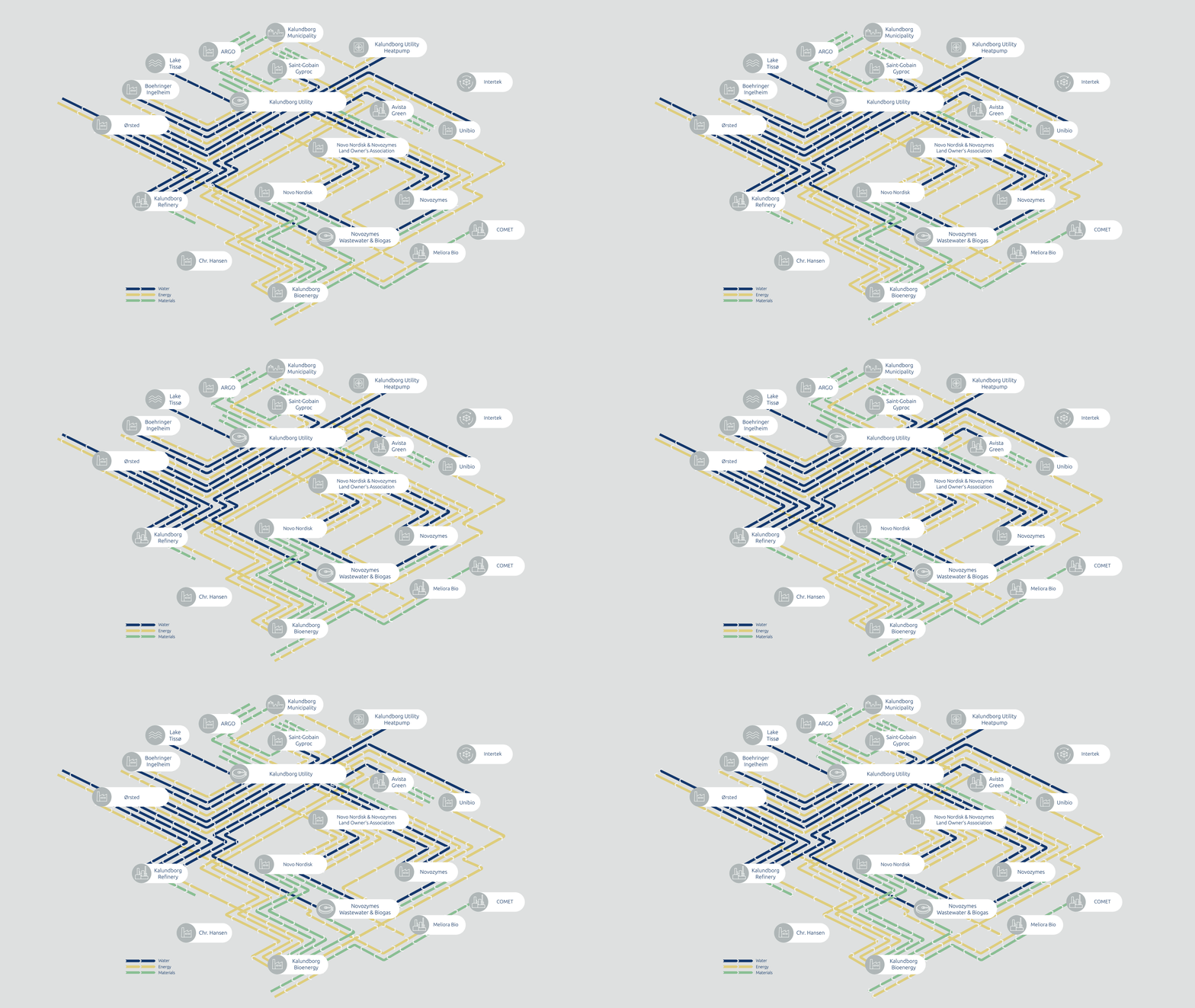
1 DAMP
Large green pipes run along the roads in Kalundborg's industrial area,
which transports steam from Asnæs Power Station to several companies
in the Kalundborg Symbiosis. The green pipes have become the symbol of
industrial symbiosis and the most visible sign of it,
that symbiosis companies are connected.
Previously, Asnæs Power Station had an overcapacity of steam,
as part of electricity generation. Over time, the steam for
Kalundborg Symbiosis has become a main product and electricity a by-product.
At Novozymes and Novo Nordisk, the steam is used for
for many different purposes, including cleaning, sterilization and distillation.
1 DAMP
Large green pipes run along the roads in Kalundborg's industrial area,
which transports steam from Asnæs Power Station to several companies
in the Kalundborg Symbiosis. The green pipes have become the symbol of
industrial symbiosis and the most visible sign of it,
that symbiosis companies are connected.
Previously, Asnæs Power Station had an overcapacity of steam,
as part of electricity generation. Over time, the steam for
Kalundborg Symbiosis has become a main product and electricity a by-product.
At Novozymes and Novo Nordisk, the steam is used for
for many different purposes, including cleaning, sterilization and distillation.
1 DAMP
Large green pipes run along the roads in Kalundborg's industrial area,
which transports steam from Asnæs Power Station to several companies
in the Kalundborg Symbiosis. The green pipes have become the symbol of
industrial symbiosis and the most visible sign of it,
that symbiosis companies are connected.
Previously, Asnæs Power Station had an overcapacity of steam,
as part of electricity generation. Over time, the steam for
Kalundborg Symbiosis has become a main product and electricity a by-product.
At Novozymes and Novo Nordisk, the steam is used for
for many different purposes, including cleaning, sterilization and distillation.
1 DAMP
Large green pipes run along the roads in Kalundborg's industrial area,
which transports steam from Asnæs Power Station to several companies
in the Kalundborg Symbiosis. The green pipes have become the symbol of
industrial symbiosis and the most visible sign of it,
that symbiosis companies are connected.
Previously, Asnæs Power Station had an overcapacity of steam,
as part of electricity generation. Over time, the steam for
Kalundborg Symbiosis has become a main product and electricity a by-product.
At Novozymes and Novo Nordisk, the steam is used for
for many different purposes, including cleaning, sterilization and distillation.
2 ELECTRICITY TO THE GRID
At Asnæsværket, green electricity is produced using
steam which drives a turbine that then generates
electricity for the grid. At Novozymes,
biogas is produced from the process wastewater from production at both
Novozymes and Novo Nordisk, as the process water contains
many nutrients. The biogas drives a large engine
that delivers 11,000 MWh per year. This corresponds to the consumption of
approximately 2,500 Danish homes. The excess heat from the large gas engine
is also used locally in the factory area for heating.
This displaces the use of fossil fuels for both electricity and heat production.
2 ELECTRICITY TO THE GRID
At Asnæsværket, green electricity is produced using
steam which drives a turbine that then generates
electricity for the grid. At Novozymes,
biogas is produced from the process wastewater from production at both
Novozymes and Novo Nordisk, as the process water contains
many nutrients. The biogas drives a large engine
that delivers 11,000 MWh per year. This corresponds to the consumption of
approximately 2,500 Danish homes. The excess heat from the large gas engine
is also used locally in the factory area for heating.
This displaces the use of fossil fuels for both electricity and heat production.
3 STEAM CONDENSATE
Steam condensate is captured from the production at Novo Nordisk
and Novozymes through steam traps from a higher to a lower pressure.
The condensate contains both heat that can be converted into energy,
and water, both of which are valuable in the production processes.
For certain purposes, the steam received from Ørsted is too hot,
therefore steam condensate is used to temperature regulate
the superheated steam. Thus, the temperature comes down
to 200 degrees and the steam pressure is reduced to 14 bar
(hereafter referred to as "saturated steam").
The excess hot condensate is utilized by extracting
the heat to heat central heating and hot process water.
The now cold condensate is used in Novozymes for mixing lye and acid,
and both Novo Nordisk and Novozymes use the condensate as a supplement
to surface water in cooling towers, thus "saving" on the consumption of surface water from Tissø.
3 STEAM CONDENSATE
Steam condensate is captured from the production at Novo Nordisk
and Novozymes through steam traps from a higher to a lower pressure.
The condensate contains both heat that can be converted into energy,
and water, both of which are valuable in the production processes.
For certain purposes, the steam received from Ørsted is too hot,
therefore steam condensate is used to temperature regulate
the superheated steam. Thus, the temperature comes down
to 200 degrees and the steam pressure is reduced to 14 bar
(hereafter referred to as "saturated steam").
The excess hot condensate is utilized by extracting
the heat to heat central heating and hot process water.
The now cold condensate is used in Novozymes for mixing lye and acid,
and both Novo Nordisk and Novozymes use the condensate as a supplement
to surface water in cooling towers, thus "saving" on the consumption of surface water from Tissø.
3 STEAM CONDENSATE
Steam condensate is captured from the production at Novo Nordisk
and Novozymes through steam traps from a higher to a lower pressure.
The condensate contains both heat that can be converted into energy,
and water, both of which are valuable in the production processes.
For certain purposes, the steam received from Ørsted is too hot,
therefore steam condensate is used to temperature regulate
the superheated steam. Thus, the temperature comes down
to 200 degrees and the steam pressure is reduced to 14 bar
(hereafter referred to as "saturated steam").
The excess hot condensate is utilized by extracting
the heat to heat central heating and hot process water.
The now cold condensate is used in Novozymes for mixing lye and acid,
and both Novo Nordisk and Novozymes use the condensate as a supplement
to surface water in cooling towers, thus "saving" on the consumption of surface water from Tissø.
4 DISTRICT HEATING
At Asnæs Power Station, district heating
is produced, of which electricity production is a by-product. District heating
is produced for the city and its industry, corresponding to the heating of 24,000 households.
The district heating is supplied to Kalundborg Utility, which distributes it to
citizens and businesses in the local area. Kalundborg Utility's heat pump
provides the city's citizens with additional heat
during the coldest months and when electricity prices are low.
Companies such as Novo Nordisk and Novozymes utilize parts of
the surplus heat generated in their own production.
The use of surplus heat is localized on the factory site and means
that fewer resources are used to produce heat.
4 DISTRICT HEATING
At Asnæs Power Station, district heating
is produced, of which electricity production is a by-product. District heating
is produced for the city and its industry, corresponding to the heating of 24,000 households.
The district heating is supplied to Kalundborg Utility, which distributes it to
citizens and businesses in the local area. Kalundborg Utility's heat pump
provides the city's citizens with additional heat
during the coldest months and when electricity prices are low.
Companies such as Novo Nordisk and Novozymes utilize parts of
the surplus heat generated in their own production.
The use of surplus heat is localized on the factory site and means
that fewer resources are used to produce heat.
4 DISTRICT HEATING
At Asnæs Power Station, district heating
is produced, of which electricity production is a by-product. District heating
is produced for the city and its industry, corresponding to the heating of 24,000 households.
The district heating is supplied to Kalundborg Utility, which distributes it to
citizens and businesses in the local area. Kalundborg Utility's heat pump
provides the city's citizens with additional heat
during the coldest months and when electricity prices are low.
Companies such as Novo Nordisk and Novozymes utilize parts of
the surplus heat generated in their own production.
The use of surplus heat is localized on the factory site and means
that fewer resources are used to produce heat.
4 DISTRICT HEATING
At Asnæs Power Station, district heating
is produced, of which electricity production is a by-product. District heating
is produced for the city and its industry, corresponding to the heating of 24,000 households.
The district heating is supplied to Kalundborg Utility, which distributes it to
citizens and businesses in the local area. Kalundborg Utility's heat pump
provides the city's citizens with additional heat
during the coldest months and when electricity prices are low.
Companies such as Novo Nordisk and Novozymes utilize parts of
the surplus heat generated in their own production.
The use of surplus heat is localized on the factory site and means
that fewer resources are used to produce heat.
4 DISTRICT HEATING
At Asnæs Power Station, district heating
is produced, of which electricity production is a by-product. District heating
is produced for the city and its industry, corresponding to the heating of 24,000 households.
The district heating is supplied to Kalundborg Utility, which distributes it to
citizens and businesses in the local area. Kalundborg Utility's heat pump
provides the city's citizens with additional heat
during the coldest months and when electricity prices are low.
Companies such as Novo Nordisk and Novozymes utilize parts of
the surplus heat generated in their own production.
The use of surplus heat is localized on the factory site and means
that fewer resources are used to produce heat.
4 DISTRICT HEATING
At Asnæs Power Station, district heating
is produced, of which electricity production is a by-product. District heating
is produced for the city and its industry, corresponding to the heating of 24,000 households.
The district heating is supplied to Kalundborg Utility, which distributes it to
citizens and businesses in the local area. Kalundborg Utility's heat pump
provides the city's citizens with additional heat
during the coldest months and when electricity prices are low.
Companies such as Novo Nordisk and Novozymes utilize parts of
the surplus heat generated in their own production.
The use of surplus heat is localized on the factory site and means
that fewer resources are used to produce heat.
4 DISTRICT HEATING
At Asnæs Power Station, district heating
is produced, of which electricity production is a by-product. District heating
is produced for the city and its industry, corresponding to the heating of 24,000 households.
The district heating is supplied to Kalundborg Utility, which distributes it to
citizens and businesses in the local area. Kalundborg Utility's heat pump
provides the city's citizens with additional heat
during the coldest months and when electricity prices are low.
Companies such as Novo Nordisk and Novozymes utilize parts of
the surplus heat generated in their own production.
The use of surplus heat is localized on the factory site and means
that fewer resources are used to produce heat.
4 DISTRICT HEATING
At Asnæs Power Station, district heating
is produced, of which electricity production is a by-product. District heating
is produced for the city and its industry, corresponding to the heating of 24,000 households.
The district heating is supplied to Kalundborg Utility, which distributes it to
citizens and businesses in the local area. Kalundborg Utility's heat pump
provides the city's citizens with additional heat
during the coldest months and when electricity prices are low.
Companies such as Novo Nordisk and Novozymes utilize parts of
the surplus heat generated in their own production.
The use of surplus heat is localized on the factory site and means
that fewer resources are used to produce heat.
4 DISTRICT HEATING
At Asnæs Power Station, district heating
is produced, of which electricity production is a by-product. District heating
is produced for the city and its industry, corresponding to the heating of 24,000 households.
The district heating is supplied to Kalundborg Utility, which distributes it to
citizens and businesses in the local area. Kalundborg Utility's heat pump
provides the city's citizens with additional heat
during the coldest months and when electricity prices are low.
Companies such as Novo Nordisk and Novozymes utilize parts of
the surplus heat generated in their own production.
The use of surplus heat is localized on the factory site and means
that fewer resources are used to produce heat.
4 DISTRICT HEATING
At Asnæs Power Station, district heating
is produced, of which electricity production is a by-product. District heating
is produced for the city and its industry, corresponding to the heating of 24,000 households.
The district heating is supplied to Kalundborg Utility, which distributes it to
citizens and businesses in the local area. Kalundborg Utility's heat pump
provides the city's citizens with additional heat
during the coldest months and when electricity prices are low.
Companies such as Novo Nordisk and Novozymes utilize parts of
the surplus heat generated in their own production.
The use of surplus heat is localized on the factory site and means
that fewer resources are used to produce heat.
4 DISTRICT HEATING
At Asnæs Power Station, district heating
is produced, of which electricity production is a by-product. District heating
is produced for the city and its industry, corresponding to the heating of 24,000 households.
The district heating is supplied to Kalundborg Utility, which distributes it to
citizens and businesses in the local area. Kalundborg Utility's heat pump
provides the city's citizens with additional heat
during the coldest months and when electricity prices are low.
Companies such as Novo Nordisk and Novozymes utilize parts of
the surplus heat generated in their own production.
The use of surplus heat is localized on the factory site and means
that fewer resources are used to produce heat.
4 DISTRICT HEATING
At Asnæs Power Station, district heating
is produced, of which electricity production is a by-product. District heating
is produced for the city and its industry, corresponding to the heating of 24,000 households.
The district heating is supplied to Kalundborg Utility, which distributes it to
citizens and businesses in the local area. Kalundborg Utility's heat pump
provides the city's citizens with additional heat
during the coldest months and when electricity prices are low.
Companies such as Novo Nordisk and Novozymes utilize parts of
the surplus heat generated in their own production.
The use of surplus heat is localized on the factory site and means
that fewer resources are used to produce heat.
5 BIOMETHANE
At Kalundborg Bioenergy, residues from
insulin and enzyme production generated
at Novo Nordisk and Novozymes, are subsequently
upgraded to biomethane equivalent to natural gas quality.
The biomethane is distributed via the natural gas grid
to Kalundborg Refinery and other end consumers.
Kalundborg Bioenergy produces both for the local natural
gas grid (4 bar) and for the national natural gas grid (19 bar).
The upgrading process removes hydrogen sulphite
and carbon dioxide, while returning sulphur from
the hydrogen sulphite to the degassed residual biomass
as an enrichment of the biogas plant's fertiliser products.
5 BIOMETHANE
At Kalundborg Bioenergy, residues from
insulin and enzyme production generated
at Novo Nordisk and Novozymes, are subsequently
upgraded to biomethane equivalent to natural gas quality.
The biomethane is distributed via the natural gas grid
to Kalundborg Refinery and other end consumers.
Kalundborg Bioenergy produces both for the local natural
gas grid (4 bar) and for the national natural gas grid (19 bar).
The upgrading process removes hydrogen sulphite
and carbon dioxide, while returning sulphur from
the hydrogen sulphite to the degassed residual biomass
as an enrichment of the biogas plant's fertiliser products.
5 BIOMETHANE
At Kalundborg Bioenergy, residues from
insulin and enzyme production generated
at Novo Nordisk and Novozymes, are subsequently
upgraded to biomethane equivalent to natural gas quality.
The biomethane is distributed via the natural gas grid
to Kalundborg Refinery and other end consumers.
Kalundborg Bioenergy produces both for the local natural
gas grid (4 bar) and for the national natural gas grid (19 bar).
The upgrading process removes hydrogen sulphite
and carbon dioxide, while returning sulphur from
the hydrogen sulphite to the degassed residual biomass
as an enrichment of the biogas plant's fertiliser products.
5 BIOMETHANE
At Kalundborg Bioenergy, residues from
insulin and enzyme production generated
at Novo Nordisk and Novozymes, are subsequently
upgraded to biomethane equivalent to natural gas quality.
The biomethane is distributed via the natural gas grid
to Kalundborg Refinery and other end consumers.
Kalundborg Bioenergy produces both for the local natural
gas grid (4 bar) and for the national natural gas grid (19 bar).
The upgrading process removes hydrogen sulphite
and carbon dioxide, while returning sulphur from
the hydrogen sulphite to the degassed residual biomass
as an enrichment of the biogas plant's fertiliser products.
5 BIOMETHANE
At Kalundborg Bioenergy, residues from
insulin and enzyme production generated
at Novo Nordisk and Novozymes, are subsequently
upgraded to biomethane equivalent to natural gas quality.
The biomethane is distributed via the natural gas grid
to Kalundborg Refinery and other end consumers.
Kalundborg Bioenergy produces both for the local natural
gas grid (4 bar) and for the national natural gas grid (19 bar).
The upgrading process removes hydrogen sulphite
and carbon dioxide, while returning sulphur from
the hydrogen sulphite to the degassed residual biomass
as an enrichment of the biogas plant's fertiliser products.
6 WASTEWATER
Kalundborg Utility is responsible for the final treatment
of the wastewater from the companies in the Kalundborg Symbiosis,
but before that, several of the partners have pre- treated it themselves,
in order to comply with legal requirements. Some types of wastewater
run in separate pipes, to allowing for an optimized treatment
and minimized energy consumptin.
The treated wastewater from the Kalundborg Utility is then passed
through a heat exchanger at the heat pump utility, which can
produce approx. 80,000 MWh per year, covering more than
30% of Kalundborg Utility's annual purchase of district heating.
6 WASTEWATER
Kalundborg Utility is responsible for the final treatment of the wastewater from the companies in the Kalundborg Symbiosis. But before that, several of the companies have pre-treated the water themselves so that it meets the authorities' requirements for each company. Some types of wastewater run in separate pipes so that treatment can be carried out optimally and with the least possible energy consumption.
The treated wastewater from the utility is then passed through a heat exchanger at the heat pump, which can produce around 80,000 MWh per year, and can cover more than 30% of Kalundborg Utility's annual purchase of district heating.
6 WASTEWATER
Kalundborg Utility is responsible for the final treatment
of the wastewater from the companies in the Kalundborg Symbiosis,
but before that, several of the partners have pre- treated it themselves,
in order to comply with legal requirements. Some types of wastewater
run in separate pipes, to allowing for an optimized treatment
and minimized energy consumptin.
The treated wastewater from the Kalundborg Utility is then passed
through a heat exchanger at the heat pump utility, which can
produce approx. 80,000 MWh per year, covering more than
30% of Kalundborg Utility's annual purchase of district heating.
6 WASTEWATER
Kalundborg Utility is responsible for the final treatment
of the wastewater from the companies in the Kalundborg Symbiosis,
but before that, several of the partners have pre- treated it themselves,
in order to comply with legal requirements. Some types of wastewater
run in separate pipes, to allowing for an optimized treatment
and minimized energy consumptin.
The treated wastewater from the Kalundborg Utility is then passed
through a heat exchanger at the heat pump utility, which can
produce approx. 80,000 MWh per year, covering more than
30% of Kalundborg Utility's annual purchase of district heating.
6 WASTEWATER
Kalundborg Utility is responsible for the final treatment
of the wastewater from the companies in the Kalundborg Symbiosis,
but before that, several of the partners have pre- treated it themselves,
in order to comply with legal requirements. Some types of wastewater
run in separate pipes, to allowing for an optimized treatment
and minimized energy consumptin.
The treated wastewater from the Kalundborg Utility is then passed
through a heat exchanger at the heat pump utility, which can
produce approx. 80,000 MWh per year, covering more than
30% of Kalundborg Utility's annual purchase of district heating.
6 WASTEWATER
Kalundborg Utility is responsible for the final treatment
of the wastewater from the companies in the Kalundborg Symbiosis,
but before that, several of the partners have pre- treated it themselves,
in order to comply with legal requirements. Some types of wastewater
run in separate pipes, to allowing for an optimized treatment
and minimized energy consumptin.
The treated wastewater from the Kalundborg Utility is then passed
through a heat exchanger at the heat pump utility, which can
produce approx. 80,000 MWh per year, covering more than
30% of Kalundborg Utility's annual purchase of district heating.
6 WASTEWATER
Kalundborg Utility is responsible for the final treatment
of the wastewater from the companies in the Kalundborg Symbiosis,
but before that, several of the partners have pre- treated it themselves,
in order to comply with legal requirements. Some types of wastewater
run in separate pipes, to allowing for an optimized treatment
and minimized energy consumptin.
The treated wastewater from the Kalundborg Utility is then passed
through a heat exchanger at the heat pump utility, which can
produce approx. 80,000 MWh per year, covering more than
30% of Kalundborg Utility's annual purchase of district heating.
6 WASTEWATER
Kalundborg Utility is responsible for the final treatment
of the wastewater from the companies in the Kalundborg Symbiosis,
but before that, several of the partners have pre- treated it themselves,
in order to comply with legal requirements. Some types of wastewater
run in separate pipes, to allowing for an optimized treatment
and minimized energy consumptin.
The treated wastewater from the Kalundborg Utility is then passed
through a heat exchanger at the heat pump utility, which can
produce approx. 80,000 MWh per year, covering more than
30% of Kalundborg Utility's annual purchase of district heating.
7 TREATED WASTE WATER
At Novozymes' treatment and biogas plant,
the first part of the treatment of process wastewater from production
takes place at both Novozymes and Novo Nordisk. The water is then led to
the final treatment at Kalundborg Forsyning.
Both processes are greatly helped by the fact that wastewater
from Novozymes and Novo Nordisk is always around 35 degrees Celsius.
This means that the microorganisms that purify the water do it faster,
more efficiently and with less energy consumption.
8 SURFACE WATER
Kalundborg Symbiosis uses 3.5 - 4 million
cubic meters of surface water from Tissø annually instead of drinking water
from the groundwater reservoirs.
The surface water is pumped in a 13 kilometer long pipeline from Tissø
to Kalundborg Utility, where the water is distributed to the companies.
The surface water is used for cooling in production and for process water
of drinking water quality in industry.
8 SURFACE WATER
Kalundborg Symbiosis uses 3.5 - 4 million
cubic meters of surface water from Tissø annually instead of drinking water
from the groundwater reservoirs.
The surface water is pumped in a 13 kilometer long pipeline from Tissø
to Kalundborg Utility, where the water is distributed to the companies.
The surface water is used for cooling in production and for process water
of drinking water quality in industry.
8 SURFACE WATER
Kalundborg Symbiosis uses 3.5 - 4 million
cubic meters of surface water from Tissø annually instead of drinking water
from the groundwater reservoirs.
The surface water is pumped in a 13 kilometer long pipeline from Tissø
to Kalundborg Utility, where the water is distributed to the companies.
The surface water is used for cooling in production and for process water
of drinking water quality in industry.
8 SURFACE WATER
Kalundborg Symbiosis uses 3.5 - 4 million
cubic meters of surface water from Tissø annually instead of drinking water
from the groundwater reservoirs.
The surface water is pumped in a 13 kilometer long pipeline from Tissø
to Kalundborg Utility, where the water is distributed to the companies.
The surface water is used for cooling in production and for process water
of drinking water quality in industry.
8 SURFACE WATER
Kalundborg Symbiosis uses 3.5 - 4 million
cubic meters of surface water from Tissø annually instead of drinking water
from the groundwater reservoirs.
The surface water is pumped in a 13 kilometer long pipeline from Tissø
to Kalundborg Utility, where the water is distributed to the companies.
The surface water is used for cooling in production and for process water
of drinking water quality in industry.
8 SURFACE WATER
Kalundborg Symbiosis uses 3.5 - 4 million
cubic meters of surface water from Tissø annually instead of drinking water
from the groundwater reservoirs.
The surface water is pumped in a 13 kilometer long pipeline from Tissø
to Kalundborg Utility, where the water is distributed to the companies.
The surface water is used for cooling in production and for process water
of drinking water quality in industry.
9 USED COOLING WATER
Used cooling water comes from Kalundborg Refinery
and is originally surface water from Tissø,
which has been used for cooling in a closed pipe system
at the refinery. The water is sent to Ørsted, which uses it
in its steam production at Asnæs Power Station.
The used cooling water has a higher temperature
than surface water from Tissø, so less energy is required
when the water is heated and turned into steam.
10 DEIONAT
When Ørsted produces electricity, the generators
are driven by steam turbines, which require the steam inside to be made
of deionized water (make-up water) from which all minerals
and salts have been removed so as not to degrade the internal parts
of the steam turbines and boilers as well as the heat pipes.
Ørsted also supplies deionized water for Kalundborg Refinery's
own production of steam, which is based on the waste heat from the refinery.
10 DEIONAT
When Ørsted produces electricity, the generators
are driven by steam turbines, which require the steam inside to be made
of deionized water (make-up water) from which all minerals
and salts have been removed so as not to degrade the internal parts
of the steam turbines and boilers as well as the heat pipes.
Ørsted also supplies deionized water for Kalundborg Refinery's
own production of steam, which is based on the waste heat from the refinery.
11 CLEANED SURFACE WATER
Of the more than 3.5 million cubic meters of surface water extracted from Tissø and used in the Kalundborg Symbiosis, more than 1.5 million cubic meters are purified to drinking water quality. It all ends up at Novozymes, where the purified surface water is used directly in Novozymes' production of industrial enzymes. This saves drinking water and protects groundwater reserves.
11 CLEANED SURFACE WATER
Of the more than 3.5 million cubic meters of surface water extracted from Tissø and used in the Kalundborg Symbiosis, more than 1.5 million cubic meters are purified to drinking water quality. It all ends up at Novozymes, where the purified surface water is used directly in Novozymes' production of industrial enzymes. This saves drinking water and protects groundwater reserves.
12 FLUE GAS CONDENSATE
At Asnæs Power Station, water is released when burning wood chips in ASV6. Asnæs Power Station cannot use the approx. 65 million liters of flue gas condensate itself, but they can use it at the neighboring Kalundborg Refinery. Once the condensate has been treated in osmosis and ion exchange plants, the clean water is piped to the refinery. Here, the purified water can be used as boiler water, which can cover about 1/3 of the needs of the Kalundborg Refinery. Without the agreement, the refinery would have to use surface water from Tissø and process it to the required quality.
13 WASTES
ARGO receives different fractions of waste from all citizens and businesses in Kalundborg Municipality, including Kalundborg Forsyning. The recyclable waste is sorted into fractions and subsequently sold to the recycling industry. The residual waste is energy utilized for electricity and heat production at Roskilde Kraftvarmeværk (ARGO).
13 WASTES
ARGO receives different fractions of waste from all citizens and businesses in Kalundborg Municipality, including Kalundborg Forsyning. The recyclable waste is sorted into fractions and subsequently sold to the recycling industry. The residual waste is energy utilized for electricity and heat production at Roskilde Kraftvarmeværk (ARGO).
14 SULPHUR
Kalundborg Refinery removes the sulphur from the oil and converts the sulphur into the fertilizer ammonium thiosulphate (ATS), which boosts plant growth. The sulphur has become a valuable resource that is sold to one of the major fertilizer producers in Denmark.
ATS is a liquid fertilizer that makes it easier for farmers to dose the amount and thus fertilize more efficiently. ATS improves the uptake of sulphur and other nutrients by plants and reduces nitrogen evaporation.
15 YEAST SLURRY
Novo Nordisk produces active pharmaceutical
ingredients by a fermentation process in which yeast cells
grow from sugars and vitamins, among other things.
When the fermentation process is complete and the active
pharmaceutical ingredient is separated, Novo
Nordisk has a nutrient-rich mixture called yeast cream.
The yeast cream is sent for treatment in the biogas plant
at Kalundborg Bioenergi.
Through gasification and after
upgrading the produced biogas, the yeast cream is utilized as biomethane and fertilizer products.
16 SAND
Kalundborg Utility treats all wastewater from homes and businesses and collects some sand from the wastewater in its sand traps. The sand consists of various sizes of pebbles and gravel and is excellent as fill for excavation work. All sand used for this purpose is washed and checked to ensure that it meets the requirements for reuse as fill.
17 SLUDGE
When Kalundborg Utility treats wastewater from households and businesses, one of the residual products is sludge. Some of the sludge is delivered to farmers who use it as fertilizer, as the sludge contains a number of nutrients. Before the sludge leaves Kalundborg Utility's central treatment plant, it is checked so that it can be spread on suitable types of agricultural land.
18 NOVOGRO
NovoGro is on the one hand a waste stream from Novo Nordisk and Novozymes, but on the other hand also a source of energy as well as a highly valued fertilizer. Initially, biogas (methane) is produced by digestion of NovoGro at Kalundborg Bioenergy. This biogas is processed and fed into the natural gas grid. The remaining product is high in the nutrients nitrogen (N), phosphorus (P) and potassium (K), which are important components of fertilizer.
19 ETHANOL WASTE
Ethanol is used in some parts of the process when Novo Nordisk produces insulin. A large part of the ethanol can be regenerated. The part of the ethanol-containing residues that cannot be regenerated is sent to Kalundborg Bioenergy. Here the ethanol residues are converted to biogas, which is then upgraded to biomethane. A small part of the ethanol waste is also sent on request to Novozymes biogas plant.
19 ETHANOL WASTE
Ethanol is used in some parts of the process when Novo Nordisk produces insulin. A large part of the ethanol can be regenerated. The part of the ethanol-containing residues that cannot be regenerated is sent to Kalundborg Bioenergy. Here the ethanol residues are converted to biogas, which is then upgraded to biomethane. A small part of the ethanol waste is also sent on request to Novozymes biogas plant.
19 ETHANOL WASTE
Ethanol is used in some parts of the process when Novo Nordisk produces insulin. A large part of the ethanol can be regenerated. The part of the ethanol-containing residues that cannot be regenerated is sent to Kalundborg Bioenergy. Here the ethanol residues are converted to biogas, which is then upgraded to biomethane. A small part of the ethanol waste is also sent on request to Novozymes biogas plant.
20 BIOMASS
Novozymes produces enzymes through a fermentation process based on agricultural raw materials such as sugar, starch and protein. When the fermentation process is over and the enzymes are separated, Novozymes is left with a nutrient-rich biomass that Kalundborg Bioenergy converts into biogas and fertilizer.
21 FERTILIZATION
Biogasified biomass from Novozymes and
Novo Nordisk, together with regenerated
sulphur, make up the ingredients of various fertilizer
products especially suitable for agriculture.
22 INDUSTRIAL RECYCLING
Many external companies are buyers of waste from the Recycling Center (ARGO) and which citizens are good at sorting into well-defined fractions. These include plastic, ROCKWOOL insulation, polystyrene, glass, cardboard, paper and clean wood. The different materials are sorted and much of it can be recycled again - into new plastic, new ROCKWOOL insulation, new polystyrene, new glass, new cardboard and paper. Clean wood can be turned into chipboard, for example.
23 REUSABLE WASTE
Some of the citizens' waste, which is well-maintained and functional materials, is collected by various organizations and associations such as the Red Cross, Ørslev sports association, Gensalg, Løves forsamlingshus and Spildlopperne in Kalundborg. The recipients then sell the materials and donate the proceeds to charity. Local citizens in Kalundborg have the opportunity to pick up compost all year round at Kalundborg Recycling Center (ARGO).
24 RECYCLING OF GYPSUM Gyproc receives gypsum waste from waste management companies and recycling stations. The gypsum is shredded from the paper covering, and then the gypsum can be used in new plasterboards, thus reducing the consumption of virgin materials.
24 RECYCLING OF GYPSUM
Gyproc receives gypsum waste from waste management companies and recycling stations. The gypsum is shredded from the paper covering, and then the gypsum can be used in new plasterboards, thus reducing the consumption of virgin materials.
25 DESULPHURIZED GYPSUM
Gyproc currently obtains de-sulphurized gypsum (DSG) from several sources, including waste incineration plants. The de-sulphurized gypsum is used in plasterboard production and lowers the consumption of virgin gypsum. Gyproc previously took desulphurized gypsum from the Asnæs power plant's flue gas cleaning, but with the plant's conversion from coal to biomass, this flow ceased. The new fraction, derived from multiple sources, was first tested in 2021 and is now fully implemented.
26 PAPER
Cover paper from recycled plasterboard contains a small amount of gypsum. The fraction is used as bedding in agriculture. After use as bedding, it re-enters the cycle when used as fertilizer/compost on fields. Alternatively, the residual paper fraction is used in waste incineration for district heating.
27 HEMICELLULOSE
Processing straw into second-generation bioethanol also produces a fraction of hemicellulose. Hemicellulose is a mixture of complex carbohydrates that can be used in food production. At COMET, in collaboration with Meliora Bio, a production line has been built to convert the hemicellulose into Arrabina prebiotics, a fiber supplement that helps the natural intestinal function to work better.
28 CONCENTRATED ORGANIC MATTER
Meliora Bio concentrates process water containing organic residual material from their production. The material, which has a high energy content, is sent to Kalundborg Bioenergi, where the organic material is used in biogas production.
29 ELECTRICITY PRODUCTION
Asnæs Power Station can produce 25 MW on the steam turbines. When producing electricity, CHP benefits are obtained in the form of cheaper district heating. This happens because the district heating cools the steam after it has been sent through the turbine. The effect of this increases the efficiency of the turbine.
30 HEATING TANKS
Inter Terminals receives hot water (90C) from Ørsted. Hot water is converted steam. The water is used to heat oil tanks. The oil is temporarily stored here in connection with the transhipment of ships.
31 USED LUBRICATING OIL
32 BOTTOM FRACTION
33 SUPPORTING FUELS